Relationship Anarchy: The Complete Guide | Second Banana
The Relationship Anarchist's Guide to Connection:
What It Really Means, Why It's More Radical Than You Think, and How to Live It
Not Just "No Labels"
Relationship anarchy gets a bad reputation it hasn't quite earned and a good reputation it sometimes hasn't quite earned either.
The bad reputation comes from the people who use the term as a sophisticated way of saying they don't want to be held to anything — who invoke "I'm a relationship anarchist" as a conversation-ending move when a partner tries to establish expectations, who treat the rejection of relationship norms as a licence for treating people carelessly. This version of relationship anarchy is not relationship anarchy. It is the absence of accountability dressed in philosophical language, and it gives the real thing a complicated name to live down.
The good reputation sometimes comes from a different kind of over-claim: the idea that relationship anarchy is the ultimate evolved form of relational consciousness, the logical conclusion of all thinking about love and connection, the practice that all other relationship styles are merely approximations of. This framing is equally unhelpful. Relationship anarchy is a specific set of values and practices that fits some people beautifully and not others at all. It is not a hierarchy of spiritual advancement.
What relationship anarchy actually is — in the thinking of Andie Nordgren, the Swedish activist who coined the term and wrote its most widely read manifesto in 2006 — is considerably more interesting and more demanding than either of these reputations suggest. It is a genuine philosophical position about the nature of connection, the construction of obligations, and the possibility of a relational life built entirely on authentic choice rather than on the categories and hierarchies that culture imposes.
This piece is the full treatment. What relationship anarchy actually means. What the smorgasbord is. How it differs from polyamory and solo poly and just being non-committal. What it demands of you in practice. And how Second Banana's architecture fits people who approach their relational and erotic lives this way.
The Origin: Andie Nordgren and the 2006 Manifesto
Relationship anarchy emerged from radical political traditions — specifically from the anarchist political philosophy that questions all imposed hierarchies and advocates for the construction of social arrangements from genuine consent rather than inherited authority. Nordgren's 2006 short manifesto, The Short Instructional Manifesto for Relationship Anarchy, applied this political sensibility to intimate relationships. It circulated in Swedish activist communities, was translated widely, and became the most commonly cited founding document of the practice.
The manifesto's central argument is this: the categories and hierarchies that mainstream culture imposes on relationships — the distinction between romantic and platonic, the assumption that romantic relationships deserve more commitment and care than friendships, the escalating model of progressive entanglement — are not natural or inevitable. They are constructed. And because they are constructed, they can be questioned and rebuilt on different foundations.
Nordgren's specific articulation involved several key principles that have remained central to relationship anarchy practice:
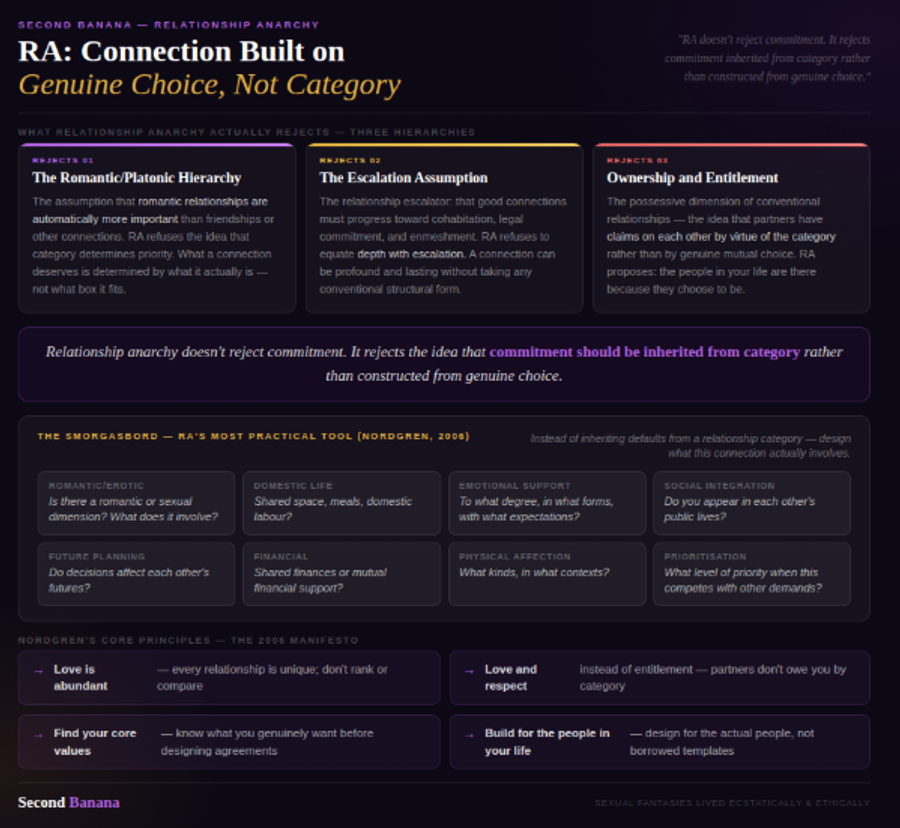
- Love is abundant and every relationship is unique — relationships should not be compared or ranked against each other
- Love and respect instead of entitlement — the people in your life are not obligated to you by virtue of your relationship category
- Find your core set of values — understand what you genuinely want and need from connections before designing agreements to meet them
- Heterosexism is rampant and needs to be dismantled — the political dimension is explicit; RA emerged partly as a critique of homonormativity, the tendency of LGBTQ+ relationships to replicate heterosexual relationship structures
- Build for the people in your life — design agreements that serve the actual people involved, not templates borrowed from culture
- Jealousy is not a proof of love — don't treat possessiveness as evidence of caring; address it with communication rather than with ownership structures
- Don't rank and compare people and relationships — resist the pressure to have a "best friend" or "primary partner" in ways that devalue other connections
- Fake it until you make it — RA is a practice, not a natural state; building it requires deliberate effort and ongoing work
The manifesto is striking for what it doesn't say as much as for what it does. It doesn't say "don't commit." It doesn't say "don't love deeply." It doesn't say "keep everything casual." It says: examine the basis on which you make commitments, and ensure that what you're committing to flows from genuine desire and genuine values rather than from external scripts about what relationships are supposed to look like.
The Core Philosophy: What RA Actually Rejects
To understand relationship anarchy, it helps to be precise about what it is rejecting — because what it rejects is more specific than it first appears.
The Romantic/Platonic Hierarchy
The most fundamental thing relationship anarchy rejects is the cultural assumption that romantic relationships are inherently more important, more deserving of commitment and care, more central to adult life, than non-romantic ones. This assumption is so deeply embedded in most people's relational framework that it functions as invisible infrastructure — the taken-for-granted background against which other assumptions are made.
The evidence that this hierarchy is real is everywhere. When someone cancels a dinner with a friend because their partner wants them home, most people consider this normal and reasonable. When someone cancels a dinner with a partner because a friend needs them, it reads as a relational problem. When resources — time, money, attention, care — need to be allocated, the romantic partner almost always wins over the friend, the colleague, the family member, without this even being experienced as a choice. The romantic relationship is simply more important — not because it actually serves people better in all cases, but because that is the cultural default.
Relationship anarchy says: question this. Not necessarily to flatten all distinctions between connections — some connections will naturally involve more time, more integration, more daily life — but to refuse the assumption that the category of romantic automatically confers primacy. To decide, instead, which connections deserve what level of investment based on what those connections actually are and what the people in them actually want.
The Escalation Assumption
Related to the romantic hierarchy is the escalation assumption: the idea that good relationships must progress, that connection deepens through increasing commitment and integration, that the failure to escalate is evidence of a relationship not being "real" or "serious." This is the relationship escalator dynamic described by Amy Gahran — the conveyor belt of progressive enmeshment that relationship anarchy deliberately steps off.
RA rejects the escalation assumption not by opposing depth or longevity, but by refusing to equate depth with escalation. A relationship can be profound, lasting, and genuinely central to both people's lives without involving cohabitation, legal commitment, or any of the other markers that the escalator treats as evidence of seriousness. The depth is in what the connection actually is — not in what structural form it has taken.
Ownership and Entitlement
Relationship anarchy also explicitly rejects what Nordgren calls "the idea that you can own another person" — the possessive dimension of conventional relationship thinking in which romantic partners are understood to have claims on each other's time, attention, emotional energy, and sexual behaviour by virtue of the relationship category itself. In conventional monogamy this manifests as the expectation of exclusivity. But even in ENM contexts, entitlement can operate through primary/secondary hierarchy, through couple privilege, through the assumption that an established partner's preferences automatically override a newer connection's.
RA proposes instead that people in your life are there because they choose to be — not because they owe you their presence by virtue of a relationship category. This shifts the basis of connection from entitlement to genuine, ongoing mutual choice. Which is both more demanding and more honest.
Relationship anarchy doesn't reject commitment. It rejects the idea that commitment should be inherited from category rather than constructed from genuine choice.
The Smorgasbord: RA's Most Practical Tool
One of the most widely used practical tools in relationship anarchy communities is the relationship anarchy smorgasbord — a visual or list-based framework for mapping out what a specific connection actually involves, without reference to category. Instead of defining a connection as "friendship" or "romantic relationship" and then inheriting the default set of behaviours associated with that category, the smorgasbord invites the people in a connection to select, from a full range of possible dimensions, which ones are present in their specific relationship.
The dimensions typically included in a smorgasbord might cover:
- Romantic or erotic connection — is there a romantic or sexual dimension? What does it involve?
- Domestic life — do you share living space, meals, domestic labour?
- Financial entanglement — shared finances, mutual financial support?
- Emotional support — to what degree, in what forms, with what expectations?
- Social integration — do you socialise together, know each other's friends and families, appear in each other's public lives?
- Future planning — do you make decisions together that affect each other's futures?
- Physical affection — what kinds, in what contexts?
- Prioritisation — what level of priority does this connection get when it competes with other demands?
The smorgasbord's power is that it separates the question of "what is this relationship?" from "what does this relationship actually involve?" Rather than inheriting a set of behaviours from a category, the people in the connection explicitly choose which elements are present — and in doing so, design something that fits their actual desires rather than a template.
A connection that involves deep emotional support, regular physical affection, and significant future planning but no sexual dimension is not well-described by either "friendship" or "romantic relationship" as those categories are typically used. The smorgasbord gives it a description that is accurate to what it actually is: this specific combination of elements, chosen by these specific people, for this specific connection.
This doesn't mean every RA connection requires an explicit smorgasbord conversation. What it means is that RA practitioners are more likely than average to be explicit about what a connection involves rather than assuming that the category conveys that information. This explicitness is, in practice, one of the most valuable things RA offers — the habit of talking about what connections actually are rather than what their labels imply they should be.
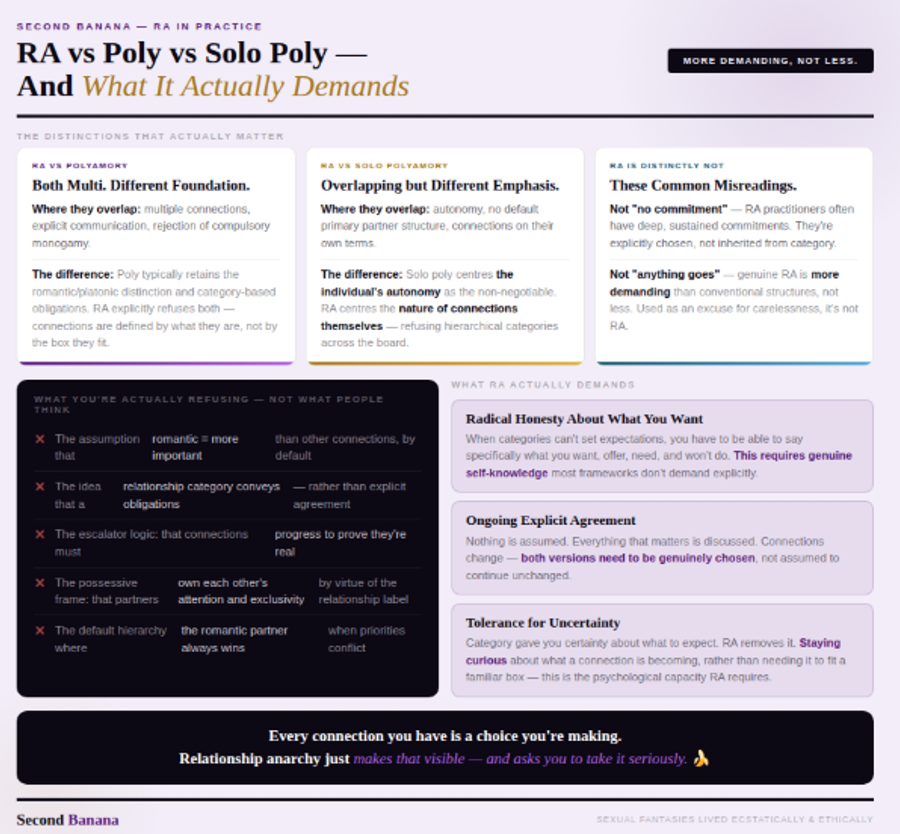
RA vs Polyamory vs Solo Poly: The Distinctions That Matter
Relationship Anarchy vs Polyamory
Polyamory and relationship anarchy are often conflated, and they do share significant territory: both involve multiple connections, both reject monogamy as a necessary structure, both involve explicit communication about what connections are. But they are not the same.
Polyamory, even in its non-hierarchical forms, typically retains the romantic/platonic distinction — multiple romantic relationships are the focus, and the romantic relationships are understood as a distinct category from friendships and other non-romantic connections. Relationship anarchy explicitly declines this distinction. A relationship anarchist may have connections that look romantic, connections that look like friendships, and connections that don't fit either category — and may resist the pressure to sort these into boxes that then determine what obligations and priorities they carry.
Polyamory also typically retains an implicit or explicit structure of commitment — an understanding that the relationships in the polycule carry obligations, that partners have claims on each other's consideration and care. RA builds these obligations explicitly and individually rather than inheriting them from category. The commitment in a relationship anarchist's connections is genuinely chosen rather than structurally assumed.
Relationship Anarchy vs Solo Polyamory
Relationship anarchy and solo polyamory overlap considerably in practice, and many people identify with both. The distinction is primarily one of emphasis.
Solo polyamory is specifically about preserving individual autonomy as the primary structure — maintaining one's own life as the centre, not seeking a nesting primary partner, keeping individual sovereignty as the non-negotiable feature of relational architecture. The focus is on the person's own autonomy and independence.
Relationship anarchy is more focused on the nature of the connections themselves — on refusing to sort them into hierarchical categories, on building obligations from genuine choice rather than category inheritance, on questioning the romantic/platonic distinction. Someone could be a relationship anarchist who does have a nesting partner, as long as that partnership is genuinely chosen and explicitly designed rather than the default primary that structures everything else.
What RA Is Distinctly Not
Relationship anarchy is not the absence of commitment. This bears repeating because it is the most common misunderstanding. RA practitioners often have deep, sustained, genuine commitments to the people in their lives. The difference is that these commitments are explicitly chosen and specifically designed rather than inherited from a relationship category.
It is not an excuse for treating people carelessly. The explicit mutual consent and ongoing communication that genuine RA requires is considerably more demanding than the default structures of conventional relationships, not less. RA done badly — used as a reason to avoid accountability — is not RA. It is self-serving philosophy.
And it is not suitable for everyone. Some people genuinely want the clarity of structure that conventional relationship categories provide, the legibility of knowing what a "partner" or "friend" means without having to construct it from scratch. This is a valid preference. RA is not more evolved — it is more suitable for people who find that category-based relationships don't fit how they actually connect.
What RA Demands in Practice
Radical Honesty About What You Actually Want
Relationship anarchy requires a level of self-knowledge and self-honesty that most relational frameworks don't demand as explicitly. When you can't rely on categories to set expectations — when you can't say "we're friends" and have both people inherit a shared understanding of what that means — you have to be able to say, specifically, what you want from a connection. What you can offer. What you need. What you're unwilling to do.
This is harder than it sounds for most people, because most people have never had to articulate these things explicitly. They've relied on categories and their associated defaults to communicate what they were offering. Relationship anarchy strips that out and requires genuine self-knowledge in its place.
The Ongoing Work of Explicit Agreement
In conventional relationships, many things are assumed. What exclusivity means, what "being together" involves, what claims partners have on each other's time and emotional energy — these are often conveyed by the relationship category rather than explicitly negotiated. In RA, because the categories don't carry these defaults, everything that matters has to be discussed explicitly.
This is not a one-time conversation. Connections change, people change, circumstances change. What an RA relationship involves today may be different from what it involves in a year — and both of those versions need to be genuinely chosen rather than assumed to continue unchanged. The ongoing work of explicit agreement is what makes RA function. Without it, you have the RA vocabulary without the RA practice.
The Capacity to Tolerate Uncertainty
One of the things that conventional relationship categories provide, for better or worse, is certainty. Knowing that you are someone's partner, or someone's friend, or someone's colleague, tells you something about what to expect and what you owe. RA removes much of this certainty, because the connection is defined by what it actually involves rather than by what a category implies.
Some people find this liberating. Some find it anxiety-inducing. The capacity to tolerate the uncertainty of connections that don't come with pre-set meanings — to stay curious about what a connection is becoming rather than needing it to fit a familiar category — is a genuine psychological capacity that RA requires and that not everyone has, or has equally.

Relationship Anarchy and Second Banana
Second Banana was built without assuming any particular relationship structure as the correct one — which makes it, structurally, one of the more congenial platforms for relationship anarchists.
The post-first model suits RA particularly well. When you begin with words — with a description of who you are, what you're looking for, what you can offer — rather than with a photograph and a categorical label, you're already doing something that resonates with the RA approach. You're defining the connection by what it actually involves rather than by what a category suggests it should.
The tag system can be used to signal RA orientation without requiring a lengthy explanation in every post. Tags like "relationship anarchist," "non-hierarchical," "building to fit," "no default structure" — these communicate the orientation to people who recognise it. The anonymous posting option is particularly useful for RA practitioners who may be navigating complex social contexts where their relational orientation would require more explanation than is appropriate for a professional or family setting.
And the community that Second Banana attracts — people who have thought carefully about what they want, who communicate explicitly, who take consent and honesty seriously, who understand that relationships can be designed rather than defaulted into — is disproportionately composed of people who will understand the RA orientation without requiring it to be justified from first principles.
The RA challenge on a dating or connection platform is communicating orientation without triggering the assumption that it means "no commitment" or "anything goes." A well-written Second Banana post can do this: be specific about what you're looking for, clear about what you can offer, honest about what you're not looking for, and anchored in the values — genuine mutual choice, explicit agreement, care without entitlement — that distinguish genuine relationship anarchy from its lesser imitators.